Showing posts with label 2011. Show all posts

Friday, March 9, 2012

National Park: William Howard Taft Home


On a whim the family decided to drive down to Cincinnati which is about 2 hours away. There was a snowstorm going on at the time, but we didn't care we were itching for something to do. Once we got to Cincy, we found a BOFA (yes, BOFA has no branches in Indiana, go figure) and made a bank deposit. After that initial stop (still can't believe BOFA doesn't have branches in Indiana) we went for some German grub at the second largest biergarten in the world (after Munich's), HofbrÀuhaus.The menu for this fine establishment can be found here. I enjoyed the sampler platter and a couple of their tasty beers while tapping my toes to the Alpen/Polka music (what do you call that German Octoberfest music when it isn't October???). We also made a trip to the Cincy IKEA to pick up some things for the house. We need one of these nearby. 

Regarding the National Park Site, William Howard Taft's house is located in a downtown neighborhood not far from the Ohio River that separates Cincinnati from Kentucky. The house is modest in stature, of the dozen or so presidential houses I have been to, this one ranks towards the bottom in its splendor (Harry Truman's is the most modest thus far) but I have quite a few to go. 

It is safe to say that Taft, the 27th US President, was a large individual. Many folks will remember the story about him needing a new bathtub installed into the White House to support his girth. I did learn less trivial facts; he was that he first president to also subsequently serve as a Chief Supreme Court Justice which meant he served alongside justices that he himself appointed. It also meant that he was the only President to give the oath of office to another president. I also found it fascinating the things that he was involved with before and after he became president. He was such an accomplished individual before he became president after Theodore Roosevelt. He served as Governor of the Phillipines, U.S. Solicitor General, Judge of the United States Court of Appeals for the Sixth Circuit, Provisional Governor of Cuba, and Secretary of War for Teddy Roosevelt. 

Taft and Roosevelt go at it.


Another interesting thing I learned was that he became a president on a wave of support for Teddy Roosevelt when TR chose not to run again after serving one full term and one abbreviated term as a result of the assassination of  President McKinley in Buffalo, NY.  This may have made Taft's term more challenging because he made decisions in office without consideration of the political consequences. When Roosevelt did decide to run again as a third party Progressive candidate to succeed him, it got ugly. While Wilson won convincingly in the election of 1912, it could be argued that the political discord between the two divided two wings of the Republican party and helped Woodrow Wilson win with a plurality but not a majority of the votes. Wilson did win a extremely large portion of the Electoral College.

Our daughter was a little fearful of the size of  President  Taft.


Thursday, March 8, 2012

National Park: Carl Sandburg Home


Who the heck is Carl Sandberg and why is there a National Park dedicated to him near Asheville, North Carolina? This was the thoughts going through my mind as I drove from Charlotte to Flat Rock, NC on a Sunday in Spring, 2011. As it turns out, this may be one of the most underrated national park sites of the ones that I have been to thus far. The location of this park is spectacular, Sandberg’s wife chose the site because is offered peace and tranquility required for Sandburg’s writing, decent year round weather and enough space for the raising of her prize-winning goats.

Connemara Front Lake
View of the house from the front lake

Carl Sandburg (1878-1967) was a writer, poet and musician from the Midwest who won the Pulitzer Prize for some of his poetry and a biography of Abraham Lincoln. He was also a social activist most notably involved in Wisconsin politics. On his death, his wife Lilian wanted his life preserved at their home, named Connemara Farms. The site has walking trails, a beautiful pond and a dairy barn that houses their goat herd. Sandburg was a prodigious talent and the site (and indeed his home) is home to hundreds of thousands of archived items including books, letters, sound recordings, telegrams, maps and photographs.

Abraham Lincoln: The Prairie Years and The War Years

I don’t know  much about his poetry or folk songs for which he is widely famous, but I do know a bit about his Abraham Lincoln biography. I am currently reading the Abraham Lincoln: The Prairie Years, and it is astounding the amount of detail he gets into about our 16th president’s life. I learned that this comes from listening to stories by individuals that knew Lincoln. The writing is as much historical as it narrative which I liken to Caro’s The Power Broker or Shelby Foote’s Civil War. Sandburg set strange hours for himself writing until the wee hours of the morning, and sleeping later than his wife. The schedule was so out of the ordinary that his wife, Lillian, slept in a separate room so she could schedule her time to care for the prize winning goats.

Sandburg's Study
Front Office

In addition to the beautiful setting, the site itself is memorable in the sense that there are so many books and historical artifacts that are left untouched. Books are left open to the page they were left open when the site was left for preservation, the calendar is set to the month/week that he passed away, the dining room table is set as if dinner would be ready that evening and the cluttered desks and workspaces indicate a constantly working mind.

Kidding Around
Mrs. Sandburg's Prize Winning Goats

After a short 20 minute tour of the house, you can take a walk to the barn where the prize winning goats are still a part of the farm. Supposedly, you can still buy a goat from her original herd. 

Thursday, October 20, 2011

National Park: Shenandoah National Park


So we decided to visit Northern Virginia and Charlottesville, VA over the Labor Day Weekend of 2011. It was a wonderful trip which involved seeing lots of family and friends. In addition to that, we took a visit to three of our National Parks that weekend: The Blue Ridge Parkway, Shenandoah National Park and Manassas Battlefield.


The Shenandoah National Park is a skinny park in western (not West by God) Virginia. It encompasses part of the Appalachian or Blue Ridge Mountains. The Skyline Drive is the most pronounced aspect of the park. This road is very popular during the fall for views of the beautiful autumn foliage. This being labor day, the park was very green and misty. 

Big Meadows in Shenandoah National Park

The drive through the park from the North (in Front Royal) to the South (in Waynesboro) is about 100 miles and takes about 3 hours of straight driving. However, you will want to stop numerous times as we did. There have got to 40 or so overlooks with beautiful vistas of the valley and the surrounding landscape. We also had an opportunity to have lunch at Harry F. Byrd Visitor Center at the Big Meadows area which is a visitor center roughly halfway through the drive. The restaurant near Big Meadows which had some great fried chicken.
The AT


Another popular feature of the park is the Appalachian Trail which runs from Georgia to Maine. There are other hiking trails in the park, but the AT is the most famous. One of my favorite trails in Shenandoah National Park is Old Rag Mountain. There are a few technical spots to the Old Rag hike, but nothing that even a novice hiker couldn't handle. There are also some stunning waterfalls in the Shenandoah National Park and plenty of wildlife. We also had to stop about a half dozen times for white tail deer the road. 

Deer in Ferns

The great thing about Shenandoah National Park is that it is close to Charlottesville, VA which is "Grammy's" hometown. We made a point of meeting up at King Family Vineyards on our way back into town to take in the view and a couple glasses of wine. 
Enjoying a game of "tag" at King Family Vineyards


Sunday, October 16, 2011

National Park: The Blue Ridge Parkway


So we decided to visit Northern Virginia and Charlottesville, VA over the Labor Day Weekend of 2011. It was a wonderful trip which involved seeing lots of family and friends. In addition to that, we took a visit to three of our National Parks that weekend: The Blue Ridge Parkway, Shenandoah National Park and Manassas Battlefield.

The Blue Ridge Parkway is probably the one National Park that I have been to most frequently due to its proximity to where I went to college and where I used to work. While I was a field sales representative, and if the timing was right, I would get on the parkway in Central Virginia and drive back to Waynesboro on a Friday evening, it helped bring me back down to earth after a busy work week. This route may not have been the most direct route home at the end of the week, but it provided nice scenery, lacked traffic lights and traffic. Prior to that, there was also an annual pilgrimage for me and my UVa pals to Humpback Rock at the beginning of the year, and then the odd occasion throughout the year. By going to Humpback Rock, however, visitors are only “dipping their toe” into the Blue Ridge Parkway.

The park starts in Waynesboro, VA at the northern end and goes through Virginia’s Appalachian Mountains and well into North Carolina. I think it is the only US National Park that is specifically a road. The views are stunning, especially in the fall when the trees are a bright orange, yellow and red. The Appalachian Mountains (older than their Rocky Mountain brothers and sisters) have a mystical look about them in the morning when the fog is laying low over them.

View from Humpback Rock near the Blue Ridge Parkway

On this occasion, I only dipped by proverbial foot in and hiked Humpback Rock. It is an easy 20-30 minute hike and it very accessible from the I-64, so it can get crowded. The Visitor’s Center doesn't open until 9AM so folks start rolling in then, but the parkway and the trails themselves are open a lot earlier. There were a few early bird hikers and photographers out there that morning, but I had enough to find my little slice of solace that Labor Day Saturday.


After the quick hike it was back to Charlottesville for a fall football game at Scott Stadium. That evening, UVa Cavaliers trounced the William and Mary Tribe.


Monday, July 11, 2011

National Park: Independence Hall National Historic Site


The concentration of downtown Philadelphia's historical sites are probably unmatched anywhere across the country. I was in Philly on a business trip with my boss. We had plans for an early dinner, but decided we would sneak in to see the Liberty Bell Exhibit before our reservation at Buddakan which was a few short blocks away. The exhibits, galleries and museums seem like private museums, and it is strange to think that you don't have to pay to enter any of these facilities (I guess it comes out of our taxes). There are a few movies or special exhibits that may require a modest fee, but I was able to walk right up to the Liberty Bell and get a the shot below in a manner of minutes.


The inscription reads in part,"PROCLAIM LIBERTY THROUGHOUT ALL THE LAND UNTO ALL THE INHABITANTS THEREOF". We only had a 20-30 minutes to take it all in, but one of the big takeaways (for me anyway) was that the Liberty Bell wasn't cracked during the announcement the Declaration of Independence on July 4th, 1776. That appears to be a myth or legend that I picked up some time in elementary school. The bell was actually manufactured in the UK, and came over in the mid-18th century. The bell actually cracked over a period of time, but the bell hasn't been rung since February 23, 1846 which is George Washington's birthday. On this day, the bell received it's fatal crack. The NPS suggests that it cracked over a long period of time of continual use. 


Independence Hall
This is the main attraction, I didn't get to see it. It is the reason I want to go back. Independence Hall is located in Chestnut Street between 5th and 6th street. It is probably one of the most important sites in US History. The building itself is not that grand, it isn't the White House or the U.S Capitol. There are other buildings of the time that are more spectacular. Furthermore, the building is dwarfed by the cityscape that has sprung up around it. It was here that both the United States Declaration of Independence and Constitution were designed, debated and signed.


Independence Visitors Center
This building could be a shopping mall as it is immense.The Independence Visitor Center is devoted to gift shops, movie theaters, special exhibits, orientation, walking tours, cafes and WIFI! I don't think it is part of the NPS, but it is adjacent to the other parks and is a magnificent area to get oriented to the sites of downtown Philly. I'll be back here too one of these days.


This is one site that I must come back to with my family so we can get the full experience and see all of the exhibits. There is just so much to see and do. In addition to the Independence Hall sites,there is the Deshler-Morris House, the Gloria Dei Church, the Edgar Allen Poe site and the Thaddeus Kosciuszko Memorial.


Wednesday, July 6, 2011

Glastonbury Fesitval of Contemporary Performing Arts: The Music, Part One


This summer I ticked of a major "Bucket List" item by attending the Glastonbury Festival of Contemporary Performing Arts in Somerset, England. My brother and his wife arranged for the the highly sought after tickets. They agreed to pick me up in Manchester, England. They also arranged for camping equipment for me. Logistically, they came through in a big way!

Glastonbury is probably the world's premiere contemporary music festival, and I have been wanting to go for over a decade. The festival has about a half dozen stages, and many more dance tents and smaller venues. The site is blocked off by an 8-9 mile perimeter fence and divided up into various areas or neighborhoods with themes. There is the Pyramid Stage (the Main Stage), the Other Stage (the secondary stage), the Avalon Stage, the John Peel Stage, etc.

Check out Radiohead's 1997 set at the festival that sold me on Glastonbury. Bands typically go all out by putting together a tight set that appeals to the masses (read greatest hits rather than new stuff they may be promoting). Couple that with fans as far as the eye can see, multiple stages, and an atmosphere of "collective togetherness" and it makes for a memorable weekend.

Here is the list of the bands that appeared on just the four biggest stages, there is no way one could see them all over the course of the Friday-Sunday festival.

Pyramid Stage
U2ColdplayBeyoncé
MorrisseyElbowPendulum
Biffy ClyroPaolo NutiniPlan B
B.B. KingTinie TempahPaul Simon
Wu-Tang ClanRumerLaura Marling
Two Door Cinema ClubThe Gaslight AnthemDon McLean
MetronomyTame ImpalaThe Low Anthem
The Master Musicians of JoujoukaStornowayFisherman's Friends

The Other Stage

Primal ScreamThe Chemical BrothersQueens of the Stone Age
Mumford & SonsWhite LiesKaiser Chiefs
Fleet FoxesFriendly FiresEels
Bright EyesJimmy Eat WorldTV on the Radio
The WombatsThe KillsBombay Bicycle Club
The VaccinesJessie JNoisettes
The Naked & FamousTwilight SingersCold War Kids
BrotherTreetop FlyersClare Maguire
Chipmunk Alice GoldDan Mangan

West Holts Stage
Cee Lo GreenBig BoiKool & The Gang
Chase and StatusJanelle MonáeHercules and Love Affair
Dr Jimmy CliffAloe BlaccThe Go! Team
Heliocentrics with MulatuFool's GoldDuane Eddy
Little DragonOmar SouleymanBellowhead
GhostpoetThe Brandt Brauer Frick EnsembleJah Wobble & the Nippon Dub Ensemble
Dengue FeverNicolas Jaar LIVEJamie Woon
ZiriguidumNarasiratoHidden Orchestra

London Afrobeat Collective

The John Peel Stage

DJ ShadowGlasvegasThe Streets
ExampleBattlesRobyn
The CoralNoah and the WhaleHurts
I Am KlootThe HorrorsThe Vaccines
Darwin DeezWarpaintEverything Everything
Cage the ElephantAnna CalviOK Go
Miles KaneDry the RiverThe Joy Formidable
MonaYuckFoster the People
StonefieldFight Like ApesRaghu Dixit
CocoonBrave YesterdayMy Tiger My Timing


One the first day, I was focused on seeing U2 so I hung out at the Pyramid Stage all afternoon and into the evening. U2 has never headlined Glastonbury. They were supposed to headline last year, but Bono hurt his back. They flew in from touring North America on their 360 tour. I saw this tour 3 times in 2009.  I am a big fan. True to form, U2 played an awesome set, although I can't stand that "Get On Your Boots" song even with it mixed up. I had never heard them play "Bad" live and was thrilled to see that one performed. It has been 20 years since Achtung Baby came out, and so I think there was a bit of an homage by playing the first five songs from that album and opening with "Even Better than the Real Thing".

This is the setlist for U2's appearance on Friday. I found some clips on youtube that are decent quality from the TV feed.
Even Better than the Real ThingThe FlyMysterious Ways, Until the End of the World, One, Where the Streets Have No Name, I Will Follow, I Still Haven't Found What I'm Looking For, Stay, Beautiful Day, Elevation, Get on Your Boots, Vertigo, Sunday Bloody Sunday, Bad, Pride (In the Name of Love), Encore: With or Without You, Moment of Surrender, Out of Control

It was a spectacular success.  Bono sang a few snippets from "She Loves You", "Jerusalem", "Never Tear Us Apart", and "Moving On Up".

This is a video of Even Better Than the Real Thing opener and the third song, Mysterious Ways.. They crushed it. The video is of poor quality because I was a sardine in a sea of people, but you get the idea of my proximity to the band, security fence, guards, etc. I could feel the bass shaking my body from the sound system (that's Larry Mullen, Jr.'s drums just thundering down and vibrating the Flip Camera).

Even Better than the Real Thing


Mysterious Ways

Primal Scream
The only downside of the performance was that this set coincided exactly with Primal Scream's set on the Other Stage. I am bummed I missed them, but I did get to see them at the 9:30 club in Washington, D.C. about 10 years ago. Movin' on Up is one of their songs that I like as performed at Glastonbury.

Morrissey 
Morrissey was another highlight for me. I am not as familiar with his solo stuff, but The Smiths frontman performed quite a few of songs from his group's catalog. I have included a few of them here. I haven't bought into the whole "mserable" thing that Morissey is known for, but one can't escape it given some of his lyrics. He also moped a bit about stage, indicating that most of the fans were there to see U2 instead of him. He also took some time to point out a political issue about circus animals being banned in the UK ahead of "Meat is Murder". It was a good set, with a very well rehearsed band. The band members were brought in from various cities around the globe.

Monday, May 30, 2011

National Park: Indiana Dunes National Lakeshore

A quick visit to Indiana Dunes National Lakeshore was all that was needed to check off the 3rd and final park in Indiana. The other two on the Indiana list were George Rogers Clark National Historic Site and the Abraham Lincoln Boyhood Home. We visited Indiana National Dunes on the way back to Indy from Chicago in early April. We had gone to Chicago for the Robert Plant concert and to see some friends do a road race. As it turns out, said friends had gotten engaged at the Dunes so we decided we must go to check out this park on the way home. Not only was this a National Park, it held sentimental value to our speedy pals. On their suggestion we decided to stick with a quick hike up Mount Baldy, the exact location of his proposal.

The trip to the park was a relatively short one, it is about 45-60 minutes outside of Chicago, and I was a bit confused at first because there is a state park that abuts (or if one gets particular about it, enclosed by) the national park. There are also steel mills dotting the highway leading to the entrance, there is a very large railroad running along the highway that leads to the park. One of the biggest companies in the world, Arcelor Mittal has a mill near the park. It seems so strange that the park is so close to this much industry. However, once you get past the steel mills and enter the park, you might as well be days from Chicago. There are about 15 miles of shoreline along Lake Michigan, with some really impressive beaches. It was too cold to go swimming that day, but it would have been refreshing on this Memorial Day 2011 (the day I write this we topped 90 degrees in Indy). The view of the water at Indiana Dunes was gorgeous! Who knew this existed in the Midwest?


Mount Baldy is probably the most popular part of the park. A short 10 minute hike gets you to the top, the dune stands about 126 feet tall, and it moves over time with the weather. The day we went was clear albeit a little windy, but the view of the water was stunning. There was a big downside though, it was right next to a power plant that looked so industrial next to this natural beauty. The drop off from the dune into the water was just majestic, but you look over to the East and there is this massive power plant tower. I decided not to take pictures of that because I didn't want to be reminded of it later.

In this park there is lots of stuff  to do (and the state park is here as well). You can walk along the beach, hike many trails, hike up Mount Baldy, go camping or canoeing, there are also important ecological tours that you can take with a park guide.

All told, we were probably in the park for about 90 minutes. We had to get back to Indy as you lose an hour on that drive, so we could only make a quick trip the park's visitor's center. I found an enchanting exhibit there on some of the artwork/advertising that was used to attract Chicagoans to the Dunes during the early 20th century.


The gallery of prints promoted the train from Chicago to the state park at the Dunes.


I remember seeing 1930s in one of the posters. I find old advertising fascinating, particularly these.

I know they have been available for years, but looking at them now it is as if they were taken from a time capsule or something.  

Sunday, May 15, 2011

National Park: Wilson's Creek National Battlefield


The National Park dedicated to the Civil War Battle called Wilson's Creek is located in Republic, Missouri. The Battle of Wilson's Creek took place on August 10, 1861. It is one of the major battles of the Civil War to have taken place west of the Mississippi River.This battle was a victory for the Confederates, but they were unable to take advantage of the win due to disorganization. The Confederate forces were unable advance as far as they could have, but the battle did give the Confederates control of Southwestern Missouri. The Union maintained control of the state.

The Missouri Compromise was passed in 1820 that allowed the pro-slavery and anti-slavery factions in the US to agree on the "legality" of slavery in the area of the Louisiana Territory. The compromise prevented slavery north of the parallel 36°30' north in the Louisiana Territory with the exception of Missouri. 

Map of the USA during the Civil War highlighting the Missouri Compromise
The Civil War Trust has spectacular maps and animations about major battles in the Civil War. Wilson's Creek Battlefield in Southern Missouri was a fascinating Civil War battle for many reasons. For someone like myself who grew up in the Southeastern United States, I didn't recall learning much about the battlefields west of the Mississippi River. Missouri is the state with the 4th most Civil War battles. This battle took place about 10 miles southwest of Springfield, Missouri. When the Civil War began in 1861, most Missourians wished to remain neutral, but the federal government though that Missouri's allegiance to the union would be vital. The Governor of Missouri had Confederate sympathies, so Missouri was a hodge-podge of divided sentiment.

Governor Jackson and Union General Lyon had a couple of skirmishes between their respective forces, and the Union General chased off the Governor and his state militia to Southwestern Missouri. The General Lyon installed a pro-Union state government and then went after the state militia in Southwestern Missouri.

Confederate General Benjamin McCulloch came north to reinforce the state militia. Both the Union and Confederate armies planned surprise attacks on August 9, but McCulloch cancelled his attack on account of the weather. The Confederates were able to hold off the surprise attack and then overwhelmed the union's flanking maneuver on a place called Bloody Hill.
Benjamin McCulloch commanded Confederate forces at Wilson's Creek 

Union General Nathaniel Lyon was the first Union General to be killed in the American Civil War. General Lyon was a staunch abolitionist. This was controversial in Missouri at the time, his troops were involved in the Camp Jackson Affair which was the slaughter of almost 30 civilians who were anti-union. Lyon helped prevent Missouri from seceding from the union. The quote, "It is no longer useful to appeal to reason, but to the sword." is attributed to him and is in reference to the Southern cause.


Nathanial Lyon was the first Union General to be killed in the American Civil War on August 10, 1861. 


While the Confederates may have won the day (only slightly), they were unable to take advantage and Missouri stayed under control of the Union.

Missouri National Park Route

Over the weekend of April 29th - May 1, 2011, I had the opportunity to take a road trip. My wife and daughter went on buisiness trip together and stayed in Western NY through the weekend. I saw this as an opportunity to head out to Missouri and visit all of the national parks in that state, and a couple in Kansas as well. I am glad that our trusty Subaru Outback was up to the challenge. I easily spent 24 hours (not continuous of course) in the car, but I accomplished what I had set out to do. I saw 8 national parks in total, 6 in Missouri and 2 in Kansas.This is the route I took over the weekend, during this time I had learned a great deal about the history of the two states, and some interesting tidbits for folks that ever travel to the area.

  • Pittsburg State Gorillas: in Kansas has to be one of the coolest mascots of which I have ever heard.
  • Pappy's Smokehouse in St. Louis, MO has some of the best BBQ ribs I have ever tasted, it is a bummer they don't serve beer there. 
  • Rheineland in Independence, MO is a quaint little German restaurant near the Harry Truman Historical area. It has a delicious sandwich on the menu call the Bavarian Loafer that is just awesome. 
  • Cafe Ventana is located near St. Louis University, and is a New Orleans style bistro with great eye-opening coffee and beignets. Great way to start the day.
  • Harry's Cafe in Pittsburg, KS has great biscuits and gravy (not better than the stuff you get in NC though)
  • Jim's Steakhouse in Pittsburg, KS was hopping at 5pm, with families having dinner. They serve a pretty tasty NY strip. 

The drive at the end of the trip was a long one. From Harry S. Truman's door to my door was about 7 hours of driving. You add the time difference from Central to Eastern and it is an 8 hour trip. I also enjoyed crossing the Mississippi River twice in this trip. The river was experiencing a high level of rain and was to crest later in the week at about 48 ft.

It was a wonderful trip, I learned a great deal. I just wish I had a bit more time to see the sights in The Ozarks and I didn't get to see the Harry S. Truman Library which was a regret. Next time I am in Kansas City, I will be sure to pop in to see this Presidential Library.

Saturday, April 30, 2011

National Park: The Ozark National Scenic Riverways


The Ozark National Scenic Riverway is located in Southwestern Missouri. It encompasses Mark Twain's National Forest (managed not by the Department of the Interior but by the Department of Agriculture) as well as a number of scenic trailways. There isn't just one site, or just one geographic feature of this park, but many. It would take days if not weeks to explore. I didn't have that kind of time today, so I just chose a couple of sites to check out and went on my way. There had been some flooding in the area, so I could not get to the Alley Mill without taking a long detour. The Alley Mill is the site that is probably the most photographed of the Ozark National Scenic Riverways. The Alley Mill is a working mill that uses a turbine instead of a water wheel and rollers instead of a grinding stone. I was bummed that I didn't get to see this structure which was built in the late 1800s. To the folks who lived in the area the mill was an important community center. It served a dual purpose of grinding wheat (as one would expect) but also as a community meeting place. While times have changed, many people return to this spot today for reunions, camping, and other activities.

The Alley Mill was built in the late 1800s.
Much of the water in the Ozark National Scenic Riverways travels underground, and spews forth through springs in the ground. I was able to see two of the water sites. The first was the Big Springs. The road was blocked off to some recent flooding, so I walked down the road a bit, and gained access across the water damaged bridge. The water had to have been a good 10-15 feet higher than it was today (and it was still high). The Big Spring is one of the world's largest springs. It generates over 275 million gallons a day of water from the ground.

Big Spring near Van Buren, MO is one of the worlds largest springs.
The second water site was Rocky Falls near Winona, MO. The falls here are postcard picturesque. There is always something soothing about waterfalls. On this particular day, because there had been so much flooding, there was a lot of white water. Had it been warmer, I might have taken a dip.

Rocky Falls near Winona, MO

Overall this park doesn't have as much history as some of the other parks that I have been to, but it is well maintained and supports lots of recreation. I would love to go canoeing down here when my daughter gets a bit older.

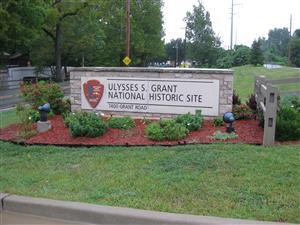
National Park: Ulysses S. Grant's White Haven Home

The site is in suburban St. Louis, Missouri


Ulyssess  S. Grant was the 18th president of the United States, while he did serve two terms as president and tried for a third, some of his presidency may have been plagued by a scandal called the Whiskey Ring. This may have made his term a little less remarkable. I think he is more memorable as the Union General during the American Civil War.  He was a West Point graduate, and fought in the Mexican-American War. But then, he kind of lost his way until the Civil War started. Before the Civil War started, he spent much of his time at a Fort in St. Louis, he met his wife, Julia Dent, at her father's house in White Haven near downtown St. Louis.

White Haven is his wife's family's property. As houses go, it is not that grand or that big. There is a substantial amount of land. The site is in the middle of suburban St. Louis and a bike path runs along it's entrance. The visitor's center has a nice film, and you can take a tour of the house itself. Because of the size, and lack of furnishings, the house is a quick tour. There are multi-media presentations there outlining St. Louis and Missouri's role in the American Civil war.

As presidential homes go, this one was rather modest in size.


Being a border state in the Western Frontier presented some inner strife in Missouri, with a lot of individuals pro-union and others pro-slave. I think the official stance at the beginning of the war was neutral, but the Governor of Missouri had Southern sympathies. This was no different in Ulysses' own family. He was born and raised in Ohio, which was a free-state and his father was against slavery. This institution was not embedded in Ulysses character. His wife, Julia, was raised in a slave state (but still neutral during the beginning of the war), and was taught that whites could own slaves, this was a proper relationship. So when Ulysses Grant moved to his wife's family farm, he actually "owned" slaves through his father-in-law. He would work along side them during the day, and debate his father-in-law at night about this institution. When the Civil War broke out, Julia's own brothers fought for different sides of the war. You can see this conflict up close in some of the multi-media presentations at the house. Ulysses moved up the ranks on the Union side when the wore broke out, and was the General that ultimately received the surrender of Robert E. Lee at Appomattox Court House, VA.
Ulysses S. Grant appears on the $50 bill.

When Ulysses S. Grant was president, and after his term was complete he did not spend much time at White Haven. He moved to New York to be close to his children. He also took a round the world trip that kept him from visiting Missouri for 2 years. The park is quaint, but not far from a lot of commercialization on nearby Gravois Street. The traffic (late on a Friday afternoon) was awful.

There are several national monuments dedicated to Grant. These include a statue of him and his horse on the National Mall and his tomb on the Upper West Side of Manhattan in New York.