Showing posts with label missouri. Show all posts

Sunday, May 15, 2011

National Park: Wilson's Creek National Battlefield


The National Park dedicated to the Civil War Battle called Wilson's Creek is located in Republic, Missouri. The Battle of Wilson's Creek took place on August 10, 1861. It is one of the major battles of the Civil War to have taken place west of the Mississippi River.This battle was a victory for the Confederates, but they were unable to take advantage of the win due to disorganization. The Confederate forces were unable advance as far as they could have, but the battle did give the Confederates control of Southwestern Missouri. The Union maintained control of the state.

The Missouri Compromise was passed in 1820 that allowed the pro-slavery and anti-slavery factions in the US to agree on the "legality" of slavery in the area of the Louisiana Territory. The compromise prevented slavery north of the parallel 36°30' north in the Louisiana Territory with the exception of Missouri. 

Map of the USA during the Civil War highlighting the Missouri Compromise
The Civil War Trust has spectacular maps and animations about major battles in the Civil War. Wilson's Creek Battlefield in Southern Missouri was a fascinating Civil War battle for many reasons. For someone like myself who grew up in the Southeastern United States, I didn't recall learning much about the battlefields west of the Mississippi River. Missouri is the state with the 4th most Civil War battles. This battle took place about 10 miles southwest of Springfield, Missouri. When the Civil War began in 1861, most Missourians wished to remain neutral, but the federal government though that Missouri's allegiance to the union would be vital. The Governor of Missouri had Confederate sympathies, so Missouri was a hodge-podge of divided sentiment.

Governor Jackson and Union General Lyon had a couple of skirmishes between their respective forces, and the Union General chased off the Governor and his state militia to Southwestern Missouri. The General Lyon installed a pro-Union state government and then went after the state militia in Southwestern Missouri.

Confederate General Benjamin McCulloch came north to reinforce the state militia. Both the Union and Confederate armies planned surprise attacks on August 9, but McCulloch cancelled his attack on account of the weather. The Confederates were able to hold off the surprise attack and then overwhelmed the union's flanking maneuver on a place called Bloody Hill.
Benjamin McCulloch commanded Confederate forces at Wilson's Creek 

Union General Nathaniel Lyon was the first Union General to be killed in the American Civil War. General Lyon was a staunch abolitionist. This was controversial in Missouri at the time, his troops were involved in the Camp Jackson Affair which was the slaughter of almost 30 civilians who were anti-union. Lyon helped prevent Missouri from seceding from the union. The quote, "It is no longer useful to appeal to reason, but to the sword." is attributed to him and is in reference to the Southern cause.


Nathanial Lyon was the first Union General to be killed in the American Civil War on August 10, 1861. 


While the Confederates may have won the day (only slightly), they were unable to take advantage and Missouri stayed under control of the Union.

Missouri National Park Route

Over the weekend of April 29th - May 1, 2011, I had the opportunity to take a road trip. My wife and daughter went on buisiness trip together and stayed in Western NY through the weekend. I saw this as an opportunity to head out to Missouri and visit all of the national parks in that state, and a couple in Kansas as well. I am glad that our trusty Subaru Outback was up to the challenge. I easily spent 24 hours (not continuous of course) in the car, but I accomplished what I had set out to do. I saw 8 national parks in total, 6 in Missouri and 2 in Kansas.This is the route I took over the weekend, during this time I had learned a great deal about the history of the two states, and some interesting tidbits for folks that ever travel to the area.

  • Pittsburg State Gorillas: in Kansas has to be one of the coolest mascots of which I have ever heard.
  • Pappy's Smokehouse in St. Louis, MO has some of the best BBQ ribs I have ever tasted, it is a bummer they don't serve beer there. 
  • Rheineland in Independence, MO is a quaint little German restaurant near the Harry Truman Historical area. It has a delicious sandwich on the menu call the Bavarian Loafer that is just awesome. 
  • Cafe Ventana is located near St. Louis University, and is a New Orleans style bistro with great eye-opening coffee and beignets. Great way to start the day.
  • Harry's Cafe in Pittsburg, KS has great biscuits and gravy (not better than the stuff you get in NC though)
  • Jim's Steakhouse in Pittsburg, KS was hopping at 5pm, with families having dinner. They serve a pretty tasty NY strip. 

The drive at the end of the trip was a long one. From Harry S. Truman's door to my door was about 7 hours of driving. You add the time difference from Central to Eastern and it is an 8 hour trip. I also enjoyed crossing the Mississippi River twice in this trip. The river was experiencing a high level of rain and was to crest later in the week at about 48 ft.

It was a wonderful trip, I learned a great deal. I just wish I had a bit more time to see the sights in The Ozarks and I didn't get to see the Harry S. Truman Library which was a regret. Next time I am in Kansas City, I will be sure to pop in to see this Presidential Library.

Saturday, April 30, 2011

National Park: The Ozark National Scenic Riverways


The Ozark National Scenic Riverway is located in Southwestern Missouri. It encompasses Mark Twain's National Forest (managed not by the Department of the Interior but by the Department of Agriculture) as well as a number of scenic trailways. There isn't just one site, or just one geographic feature of this park, but many. It would take days if not weeks to explore. I didn't have that kind of time today, so I just chose a couple of sites to check out and went on my way. There had been some flooding in the area, so I could not get to the Alley Mill without taking a long detour. The Alley Mill is the site that is probably the most photographed of the Ozark National Scenic Riverways. The Alley Mill is a working mill that uses a turbine instead of a water wheel and rollers instead of a grinding stone. I was bummed that I didn't get to see this structure which was built in the late 1800s. To the folks who lived in the area the mill was an important community center. It served a dual purpose of grinding wheat (as one would expect) but also as a community meeting place. While times have changed, many people return to this spot today for reunions, camping, and other activities.

The Alley Mill was built in the late 1800s.
Much of the water in the Ozark National Scenic Riverways travels underground, and spews forth through springs in the ground. I was able to see two of the water sites. The first was the Big Springs. The road was blocked off to some recent flooding, so I walked down the road a bit, and gained access across the water damaged bridge. The water had to have been a good 10-15 feet higher than it was today (and it was still high). The Big Spring is one of the world's largest springs. It generates over 275 million gallons a day of water from the ground.

Big Spring near Van Buren, MO is one of the worlds largest springs.
The second water site was Rocky Falls near Winona, MO. The falls here are postcard picturesque. There is always something soothing about waterfalls. On this particular day, because there had been so much flooding, there was a lot of white water. Had it been warmer, I might have taken a dip.

Rocky Falls near Winona, MO

Overall this park doesn't have as much history as some of the other parks that I have been to, but it is well maintained and supports lots of recreation. I would love to go canoeing down here when my daughter gets a bit older.

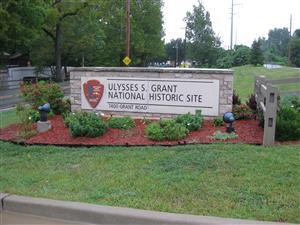
National Park: Ulysses S. Grant's White Haven Home

The site is in suburban St. Louis, Missouri


Ulyssess  S. Grant was the 18th president of the United States, while he did serve two terms as president and tried for a third, some of his presidency may have been plagued by a scandal called the Whiskey Ring. This may have made his term a little less remarkable. I think he is more memorable as the Union General during the American Civil War.  He was a West Point graduate, and fought in the Mexican-American War. But then, he kind of lost his way until the Civil War started. Before the Civil War started, he spent much of his time at a Fort in St. Louis, he met his wife, Julia Dent, at her father's house in White Haven near downtown St. Louis.

White Haven is his wife's family's property. As houses go, it is not that grand or that big. There is a substantial amount of land. The site is in the middle of suburban St. Louis and a bike path runs along it's entrance. The visitor's center has a nice film, and you can take a tour of the house itself. Because of the size, and lack of furnishings, the house is a quick tour. There are multi-media presentations there outlining St. Louis and Missouri's role in the American Civil war.

As presidential homes go, this one was rather modest in size.


Being a border state in the Western Frontier presented some inner strife in Missouri, with a lot of individuals pro-union and others pro-slave. I think the official stance at the beginning of the war was neutral, but the Governor of Missouri had Southern sympathies. This was no different in Ulysses' own family. He was born and raised in Ohio, which was a free-state and his father was against slavery. This institution was not embedded in Ulysses character. His wife, Julia, was raised in a slave state (but still neutral during the beginning of the war), and was taught that whites could own slaves, this was a proper relationship. So when Ulysses Grant moved to his wife's family farm, he actually "owned" slaves through his father-in-law. He would work along side them during the day, and debate his father-in-law at night about this institution. When the Civil War broke out, Julia's own brothers fought for different sides of the war. You can see this conflict up close in some of the multi-media presentations at the house. Ulysses moved up the ranks on the Union side when the wore broke out, and was the General that ultimately received the surrender of Robert E. Lee at Appomattox Court House, VA.
Ulysses S. Grant appears on the $50 bill.

When Ulysses S. Grant was president, and after his term was complete he did not spend much time at White Haven. He moved to New York to be close to his children. He also took a round the world trip that kept him from visiting Missouri for 2 years. The park is quaint, but not far from a lot of commercialization on nearby Gravois Street. The traffic (late on a Friday afternoon) was awful.

There are several national monuments dedicated to Grant. These include a statue of him and his horse on the National Mall and his tomb on the Upper West Side of Manhattan in New York.