Monday, June 20, 2011

Orlando, Epcot Center and Downtown Disney

Spaceship Earth
Spaceship Earth at Epcot Center

We had a great opportunity this past week, Kate had a business trip that took her to Orlando to meet with many of her global counterparts. I stayed in Indy and worked as a Mr. Mom for part of the week. Everything went smoothly as Mr. Mom, so I relished in the opportunity to join Kate on Thursday evening for a 3 day weekend in sunny (and extremely hot Orlando).


We stayed at the Hilton Orlando Bonnet Creek at a reduced rate because Kate's company had rented out the entire place, and we were able to get our hands on a free ticket to Epcot (after 4pm) thanks to some work connections. Epcot Center is probably the most "grown up" of the Disney parks which isn't saying much...


There are *some* educational opportunities here. There are areas of the park dedicated to "Using your Imagination", an aquarium that also has a "Finding Nemo" ride. One of the highlights of the trip was going into the "Spaceship Earth". Which was a curious tour back into history, and into the future. Towards the end of the ride, our console asked us a few questions, and it gave us our future. Space ship earth is probably the most iconic of all Epcot's attractions.


This wasn't the first time that I had been to Epcot Center. I went once when I was a teenager, and distinct memory that I have is the "dancing fountains" at Epcot. My brother and I thought we were so cool because we figured out that if you stand in the right spot at the right time, you get soaked with gloriously refreshing water in a steamy Florida day. During this 2011 trip, there was a pair of boys doing the exact same thing as we did then. Of course it is easier now when I am 6 feet tall!


We had dinner in "Morocco" with a belly dancer, and yes the 3D Michael Jackson flick, Captain Eo, is still playing to enraptured audiences every 30 minutes.


I'll also mention customer service on this trip. Disney has prided itself on making visitor's experience memorable, and they certainly delivered. Mears Transportation, the service that took us from the hotel to Epcot also came through in a big way. In our excitement to get into the park, I left our diaper bag and camera on the bus. They sent a "rover" out to meet the bus, and returned the diaper bag. We hardly lost any time at all and recovered some important belongings (namely diapers and a camera). 

Monday, May 30, 2011

National Park: Indiana Dunes National Lakeshore

A quick visit to Indiana Dunes National Lakeshore was all that was needed to check off the 3rd and final park in Indiana. The other two on the Indiana list were George Rogers Clark National Historic Site and the Abraham Lincoln Boyhood Home. We visited Indiana National Dunes on the way back to Indy from Chicago in early April. We had gone to Chicago for the Robert Plant concert and to see some friends do a road race. As it turns out, said friends had gotten engaged at the Dunes so we decided we must go to check out this park on the way home. Not only was this a National Park, it held sentimental value to our speedy pals. On their suggestion we decided to stick with a quick hike up Mount Baldy, the exact location of his proposal.

The trip to the park was a relatively short one, it is about 45-60 minutes outside of Chicago, and I was a bit confused at first because there is a state park that abuts (or if one gets particular about it, enclosed by) the national park. There are also steel mills dotting the highway leading to the entrance, there is a very large railroad running along the highway that leads to the park. One of the biggest companies in the world, Arcelor Mittal has a mill near the park. It seems so strange that the park is so close to this much industry. However, once you get past the steel mills and enter the park, you might as well be days from Chicago. There are about 15 miles of shoreline along Lake Michigan, with some really impressive beaches. It was too cold to go swimming that day, but it would have been refreshing on this Memorial Day 2011 (the day I write this we topped 90 degrees in Indy). The view of the water at Indiana Dunes was gorgeous! Who knew this existed in the Midwest?


Mount Baldy is probably the most popular part of the park. A short 10 minute hike gets you to the top, the dune stands about 126 feet tall, and it moves over time with the weather. The day we went was clear albeit a little windy, but the view of the water was stunning. There was a big downside though, it was right next to a power plant that looked so industrial next to this natural beauty. The drop off from the dune into the water was just majestic, but you look over to the East and there is this massive power plant tower. I decided not to take pictures of that because I didn't want to be reminded of it later.

In this park there is lots of stuff  to do (and the state park is here as well). You can walk along the beach, hike many trails, hike up Mount Baldy, go camping or canoeing, there are also important ecological tours that you can take with a park guide.

All told, we were probably in the park for about 90 minutes. We had to get back to Indy as you lose an hour on that drive, so we could only make a quick trip the park's visitor's center. I found an enchanting exhibit there on some of the artwork/advertising that was used to attract Chicagoans to the Dunes during the early 20th century.


The gallery of prints promoted the train from Chicago to the state park at the Dunes.


I remember seeing 1930s in one of the posters. I find old advertising fascinating, particularly these.

I know they have been available for years, but looking at them now it is as if they were taken from a time capsule or something.  

Monday, May 16, 2011

The National Park Blanket

When we visit one of our National Parks, we pick up a patch to help commemorate the occasion. When I get a bulk of them collected, I take them down to Lee's Tailoring in on the Northside of Indianapolis, and ask him to apply the new patches. 

Here is the family's National Park Blanket on May 16, 2011
This is a small project for Lee as he is often doing suits and tuxedos as well as other more traditional alterations, but he agrees to put on the patches with a smile (and a fee, of course). 

Our daughter already likes to look at the different patches. 
The more places we go, the more patches we will have. The hope is that the blanket is fully covered one day with patches from all the parks and historical sites in the US. It probably won't happen until we retire or hit the lottery, but it is a fun little collection that we'll have together with our daughter.


Our daughter has been to many of the nations parks with us, but I have done many on my own.
During my recent to trip Missouri, I  was able to check off all the parks and sites in that state. I have also been to all of the parks in Indiana. We have only scratched the surface in Virginia, North Carolina, New York, and Washington, D.C.

Each patch has an interesting personal and (of course) historical story.
Business travel has only helped me check a few off the list on one occasion. I may get to one park in Philly on a business trip.
Her favorite thus far was the Jefferson Memorial in Washington, D.C.
Her least favorite thus far has been Mammoth Cave in Kentucky. The tour started just around nap time, so we'll write that one off.

Sunday, May 15, 2011

National Park: Wilson's Creek National Battlefield


The National Park dedicated to the Civil War Battle called Wilson's Creek is located in Republic, Missouri. The Battle of Wilson's Creek took place on August 10, 1861. It is one of the major battles of the Civil War to have taken place west of the Mississippi River.This battle was a victory for the Confederates, but they were unable to take advantage of the win due to disorganization. The Confederate forces were unable advance as far as they could have, but the battle did give the Confederates control of Southwestern Missouri. The Union maintained control of the state.

The Missouri Compromise was passed in 1820 that allowed the pro-slavery and anti-slavery factions in the US to agree on the "legality" of slavery in the area of the Louisiana Territory. The compromise prevented slavery north of the parallel 36°30' north in the Louisiana Territory with the exception of Missouri. 

Map of the USA during the Civil War highlighting the Missouri Compromise
The Civil War Trust has spectacular maps and animations about major battles in the Civil War. Wilson's Creek Battlefield in Southern Missouri was a fascinating Civil War battle for many reasons. For someone like myself who grew up in the Southeastern United States, I didn't recall learning much about the battlefields west of the Mississippi River. Missouri is the state with the 4th most Civil War battles. This battle took place about 10 miles southwest of Springfield, Missouri. When the Civil War began in 1861, most Missourians wished to remain neutral, but the federal government though that Missouri's allegiance to the union would be vital. The Governor of Missouri had Confederate sympathies, so Missouri was a hodge-podge of divided sentiment.

Governor Jackson and Union General Lyon had a couple of skirmishes between their respective forces, and the Union General chased off the Governor and his state militia to Southwestern Missouri. The General Lyon installed a pro-Union state government and then went after the state militia in Southwestern Missouri.

Confederate General Benjamin McCulloch came north to reinforce the state militia. Both the Union and Confederate armies planned surprise attacks on August 9, but McCulloch cancelled his attack on account of the weather. The Confederates were able to hold off the surprise attack and then overwhelmed the union's flanking maneuver on a place called Bloody Hill.
Benjamin McCulloch commanded Confederate forces at Wilson's Creek 

Union General Nathaniel Lyon was the first Union General to be killed in the American Civil War. General Lyon was a staunch abolitionist. This was controversial in Missouri at the time, his troops were involved in the Camp Jackson Affair which was the slaughter of almost 30 civilians who were anti-union. Lyon helped prevent Missouri from seceding from the union. The quote, "It is no longer useful to appeal to reason, but to the sword." is attributed to him and is in reference to the Southern cause.


Nathanial Lyon was the first Union General to be killed in the American Civil War on August 10, 1861. 


While the Confederates may have won the day (only slightly), they were unable to take advantage and Missouri stayed under control of the Union.

Missouri National Park Route

Over the weekend of April 29th - May 1, 2011, I had the opportunity to take a road trip. My wife and daughter went on buisiness trip together and stayed in Western NY through the weekend. I saw this as an opportunity to head out to Missouri and visit all of the national parks in that state, and a couple in Kansas as well. I am glad that our trusty Subaru Outback was up to the challenge. I easily spent 24 hours (not continuous of course) in the car, but I accomplished what I had set out to do. I saw 8 national parks in total, 6 in Missouri and 2 in Kansas.This is the route I took over the weekend, during this time I had learned a great deal about the history of the two states, and some interesting tidbits for folks that ever travel to the area.

  • Pittsburg State Gorillas: in Kansas has to be one of the coolest mascots of which I have ever heard.
  • Pappy's Smokehouse in St. Louis, MO has some of the best BBQ ribs I have ever tasted, it is a bummer they don't serve beer there. 
  • Rheineland in Independence, MO is a quaint little German restaurant near the Harry Truman Historical area. It has a delicious sandwich on the menu call the Bavarian Loafer that is just awesome. 
  • Cafe Ventana is located near St. Louis University, and is a New Orleans style bistro with great eye-opening coffee and beignets. Great way to start the day.
  • Harry's Cafe in Pittsburg, KS has great biscuits and gravy (not better than the stuff you get in NC though)
  • Jim's Steakhouse in Pittsburg, KS was hopping at 5pm, with families having dinner. They serve a pretty tasty NY strip. 

The drive at the end of the trip was a long one. From Harry S. Truman's door to my door was about 7 hours of driving. You add the time difference from Central to Eastern and it is an 8 hour trip. I also enjoyed crossing the Mississippi River twice in this trip. The river was experiencing a high level of rain and was to crest later in the week at about 48 ft.

It was a wonderful trip, I learned a great deal. I just wish I had a bit more time to see the sights in The Ozarks and I didn't get to see the Harry S. Truman Library which was a regret. Next time I am in Kansas City, I will be sure to pop in to see this Presidential Library.

Saturday, April 30, 2011

National Park: The Ozark National Scenic Riverways


The Ozark National Scenic Riverway is located in Southwestern Missouri. It encompasses Mark Twain's National Forest (managed not by the Department of the Interior but by the Department of Agriculture) as well as a number of scenic trailways. There isn't just one site, or just one geographic feature of this park, but many. It would take days if not weeks to explore. I didn't have that kind of time today, so I just chose a couple of sites to check out and went on my way. There had been some flooding in the area, so I could not get to the Alley Mill without taking a long detour. The Alley Mill is the site that is probably the most photographed of the Ozark National Scenic Riverways. The Alley Mill is a working mill that uses a turbine instead of a water wheel and rollers instead of a grinding stone. I was bummed that I didn't get to see this structure which was built in the late 1800s. To the folks who lived in the area the mill was an important community center. It served a dual purpose of grinding wheat (as one would expect) but also as a community meeting place. While times have changed, many people return to this spot today for reunions, camping, and other activities.

The Alley Mill was built in the late 1800s.
Much of the water in the Ozark National Scenic Riverways travels underground, and spews forth through springs in the ground. I was able to see two of the water sites. The first was the Big Springs. The road was blocked off to some recent flooding, so I walked down the road a bit, and gained access across the water damaged bridge. The water had to have been a good 10-15 feet higher than it was today (and it was still high). The Big Spring is one of the world's largest springs. It generates over 275 million gallons a day of water from the ground.

Big Spring near Van Buren, MO is one of the worlds largest springs.
The second water site was Rocky Falls near Winona, MO. The falls here are postcard picturesque. There is always something soothing about waterfalls. On this particular day, because there had been so much flooding, there was a lot of white water. Had it been warmer, I might have taken a dip.

Rocky Falls near Winona, MO

Overall this park doesn't have as much history as some of the other parks that I have been to, but it is well maintained and supports lots of recreation. I would love to go canoeing down here when my daughter gets a bit older.

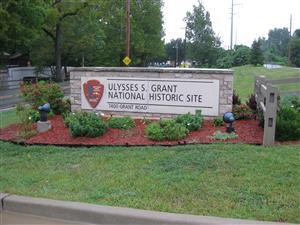
National Park: Ulysses S. Grant's White Haven Home

The site is in suburban St. Louis, Missouri


Ulyssess  S. Grant was the 18th president of the United States, while he did serve two terms as president and tried for a third, some of his presidency may have been plagued by a scandal called the Whiskey Ring. This may have made his term a little less remarkable. I think he is more memorable as the Union General during the American Civil War.  He was a West Point graduate, and fought in the Mexican-American War. But then, he kind of lost his way until the Civil War started. Before the Civil War started, he spent much of his time at a Fort in St. Louis, he met his wife, Julia Dent, at her father's house in White Haven near downtown St. Louis.

White Haven is his wife's family's property. As houses go, it is not that grand or that big. There is a substantial amount of land. The site is in the middle of suburban St. Louis and a bike path runs along it's entrance. The visitor's center has a nice film, and you can take a tour of the house itself. Because of the size, and lack of furnishings, the house is a quick tour. There are multi-media presentations there outlining St. Louis and Missouri's role in the American Civil war.

As presidential homes go, this one was rather modest in size.


Being a border state in the Western Frontier presented some inner strife in Missouri, with a lot of individuals pro-union and others pro-slave. I think the official stance at the beginning of the war was neutral, but the Governor of Missouri had Southern sympathies. This was no different in Ulysses' own family. He was born and raised in Ohio, which was a free-state and his father was against slavery. This institution was not embedded in Ulysses character. His wife, Julia, was raised in a slave state (but still neutral during the beginning of the war), and was taught that whites could own slaves, this was a proper relationship. So when Ulysses Grant moved to his wife's family farm, he actually "owned" slaves through his father-in-law. He would work along side them during the day, and debate his father-in-law at night about this institution. When the Civil War broke out, Julia's own brothers fought for different sides of the war. You can see this conflict up close in some of the multi-media presentations at the house. Ulysses moved up the ranks on the Union side when the wore broke out, and was the General that ultimately received the surrender of Robert E. Lee at Appomattox Court House, VA.
Ulysses S. Grant appears on the $50 bill.

When Ulysses S. Grant was president, and after his term was complete he did not spend much time at White Haven. He moved to New York to be close to his children. He also took a round the world trip that kept him from visiting Missouri for 2 years. The park is quaint, but not far from a lot of commercialization on nearby Gravois Street. The traffic (late on a Friday afternoon) was awful.

There are several national monuments dedicated to Grant. These include a statue of him and his horse on the National Mall and his tomb on the Upper West Side of Manhattan in New York.